


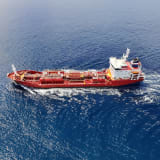






A month since Iran’s Revolutionary Guard Corps declared the Strait of Hormuz closed to U.S. and allied vessels, and the situation remains dire. Daily transits have collapsed from roughly 60 vessels/day in 2025 to just 30-40 per week. The LPG picture is equally bad as against an average of 166 VLGCs/month through Hormuz in 4Q25, only 13 have left through the strait of Hormuz for the period 3-29 March.
The situation appears to be escalating with little off-ramp for either side. Missile and drone strikes have spread to energy infrastructure and key ports across the region, taking vast amounts of supply offline even before accounting for the strait closure itself. Saudi Arabia’s Juaymah LPG export terminal was already offline from 23 February after a trestle pipe carrying propane and butane collapsed, with repairs expected to take at least a month but likely delayed with the current situation. That loss in LPG supply has since been compounded by widespread damage across the Middle Eastern suppliers.
The most consequential single strike was on Ras Laffan in Qatar, where Iranian missiles hit LNG facilities and triggered extensive fires, including at Shell’s gas-to-liquids plant. According to officials, repairs are estimated to take 3-5 years. In the UAE, Ruwais refinery and the Shah gas field both halted following a drone strike, while Das Island LNG is running at reduced output with no export route. Habshan gas facilities were shut by debris from an intercepted strike but have since restarted. Saudi Arabia’s SAMREF refinery and Ras Tanura, the Kingdom’s largest crude processing facility at 550,000 bpd, were briefly knocked out by drone attacks before restarting. Bahrain’s 400,000 bpd Bapco Energies plant was damaged and declared force majeure. Kuwait’s Mina Al-Ahmadi has curtailed operations following strikes, Mina Abdullah was hit on 19 March, and Kuwait’s overall oil output has been cut by at least half due to full storage. Iraq’s Lanaz refinery in Erbil suspended operations after a drone caused fire. On the Iranian side, Israeli strikes have knocked several South Pars production units offline and targeted a gas pressure-regulation station in Isfahan province. This is far from a complete list, and more damage is likely to follow.
On the export side, Yanbu on the Red Sea has resumed loadings following an Iranian attack and is now the critical lifeline for Saudi LPG exports. AIS data shows that March volumes are up, but only by additional 4 VLGCs compared to last month. With Yanbu being the only viable diversion route for GCC producers, and the vast majority of Middle East Gulf cargoes remain trapped behind Hormuz.
Despite the loss of LPG volumes out of the MEG, VLGC freight rates are at year-to-date highs. Surging LPG prices and supply uncertainty have driven strong demand for prompt tonnage, pushing the Baltic BLPG3 Houston-Chiba rate up $21.00/t from 27 February to $168.50/t on 27 March. However, these levels are unsustainable. Pre-war, roughly 35% of VLGC loadings originated in the Middle East Gulf, representing around 22% of global VLGC tonne-miles.
Unlike other commodity sectors, there is simply not enough spare LPG terminal capacity elsewhere to absorb that volume. U.S. exporters are already near maximum utilisation, with the only credible upside coming from Enterprise’s Neches River Phase 2 (~11 Mtpa, though largely ethane focused) in 2Q26 and Houston terminal expansions in 4Q26. The Galena Park debottlenecking expansion that was set to lift volumes has now been derailed with Targa Resources declaring a force majeure on LPG loadings from Galena Park on 18 March. Mechanical damage to a key propane compressor unit has cut the terminal to around 70% capacity, significant given Galena Park is the U.S.’s third largest LPG export site, handling nearly a quarter of all US LPG exports. As U.S. export capacity tightens, the resulting pressure has driven LPG terminal fees to their highest levels in over ten years.
Volume is one problem, but product mix is another. Middle East Gulf exports typically ran a 50-50 propane-butane split, while the U.S. is heavily propane-weighted. Despite increasing its butane share recently, the U.S. cannot fill the butane gap left by the Middle East Gulf’s absence.
The only potential relief is a rumoured Iranian transit corridor. Fourteen LPG vessels have passed through Hormuz since the 3 March closure, 13 VLGCs and 1 MGC, all discharging in China, India or Pakistan. Likely a coincidence as before the conflict, over 80% of Middle East Gulf LPG volumes were destined for India or China. But over the past weeks it’s become clear that both of these countries’ fleets have been given permission to pass through the strait. A broader quidpro-quo between Iran, China and India could normalise VLGC transits to some degree, but likely only for Iranian LPG volumes. For the rest of GCC, the rumoured $2 million toll fee could be the key mechanism for LPG volumes to return to the market, though how much supply that would ultimately unlock is uncertain. Reports indicate IRGC has already been paid in at least two instances to grant permission for transit. At the same time, Iranian legislators are moving toward establishing a long-term framework for transit-fee mechanism for the strait.

Though Hormuz is still effectively closed, the insurance picture matters for when volumes eventually recover. Major P&I clubs and war risk insurers continue to cover vessels in the region, but the designated war risk zone has expanded significantly (as seen from the map above) and premiums have surged. Hull war risk rates now stand at 0.15%-0.25% for the wider region, climbing to 5%-10% for Hormuz transits specifically. Vessels with U.S., UK or Israeli links are quoted at the top end of those ranges.
In the meantime, the freight market faces significant downside. As vessels discharge their Middle East Gulf cargoes and reposition to the Atlantic in search of replacement cargo, it should become clear that the prompt demand supporting current rates will soon evaporate. Once ships begin piling up outside the U.S. Gulf against constrained terminal capacity, rates should fall quickly, with the lowest offer securing a slot at the terminals. And with Trump signalling a willingness to cede the Strait of Hormuz to Iran and walk away from the conflict entirely, it remains a question of what the new normal for the Middle East looks like going forward.
Articles
You may also be
interested in
View all


Get in touch
Contact us today to find out how our expert team can support your business