



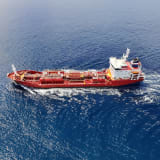






Saudi Arabia’s rapid rise as a major global fertiliser exporter is closely linked to its diversification away from oil and food security ambitions under Vision 2030, with dry bulk shipping playing a central enabling role. Fertiliser exports, particularly urea, DAP and MAP, have become an increasingly important pillar of the Kingdom’s strategy. Between January and September 2025, combined exports of DAP/MAP, AS, NP/NPS, NPK, sulphur, MOP and urea reached 11.5 Mt, up 0.8 Mt on the year and representing a 181% increase compared with the same period in 2020, according to CRU.
At the centre of this model are Saudi Basic Industries Corporation (SABIC), Saudi Agricultural and Livestock Investment Company (SALIC) and the national carrier Bahri. Fertiliser volumes from SABIC and other Saudi energy-linked producers are increasingly routed through Bahri-controlled tonnage, ensuring priority access to vessels and alignment with national trade and food security objectives. Bahri operates a mixed dry bulk fleet to support these flows, including around ten Kamsarmax vessels primarily employed on US Gulf and East Coast South America grain trades, alongside Ultramax and Handysize vessels exporting fertilisers from Saudi Arabia to the US Gulf and ECSA, before lifting grain back into the Arabian Gulf.
This logistics structure enables an efficient westbound-eastbound trade pattern, directly supporting SALIC’s food security mandate. A significant share of fertiliser cargoes function as backhaul stems and require clean holds. However, elevated regional risk premiums, fixed laycans, strict vessel specifications and commercial requirements to discharge at 2-3 ports limit the pool of willing tonnage. As a result, owners often demand premiums to call Saudi ports despite Atlantic repositioning benefits. While Bahri-owned vessels receive priority, market sources suggest that roughly 70% of Saudi fertiliser volumes are still carried on third-party spot tonnage.
Beyond logistics integration, rising Indian demand has been a key driver of Saudi’s export growth. India’s fertiliser requirements continue to expand due to population growth, limited domestic supply and persistent nutrient deficits, while policymakers have actively sought to diversify away from Chinese supply after an informal export suspension since November 2024. With Indian DAP inventories at just 1.6 Mt as of July 2025, according to Afriqom, buyers were forced to secure alternative urea and DAP/MAP supplies at short notice. Saudi Arabia emerged as a natural substitute given its proximity and supply reliability. In July 2025, Saudi Arabian Mining Company (Ma’aden) signed a five-year agreement to export 3.1 Mtpa of DAP and NPS to India. Against current capacity of 6.0 Mtpa, rising to 7.5 Mtpa in 2026, this contract represents a significant share of Saudi export availability.
Saudi Arabia’s fertiliser expansion should be viewed as a reallocation of global supply rather than a net increase in traded volumes, with Saudi material increasingly substituting curtailed Chinese exports, particularly into India. For Indian routes, this substitution does not increase tonne-mile demand and in some cases shortens sailing distances. The impact therefore lies not in distance but in structure: commercial requirements concentrate demand into a narrower pool of suitable vessels. As a result, Saudi Arabia’s growing role in fertiliser trade is selectively supportive for compliant Ultramax and Handysize tonnage on Middle East-South Asia and Atlantic backhaul trades, without representing a structurally bullish shift for global dry bulk demand.
By Vriddhi Khattar, Dry Bulk Analyst, Research, SSY
Articles
You may also be
interested in
View all

Get in touch
Contact us today to find out how our expert team can support your business